

The Think Thermally and MotorTalk blogs are updated monthly, written by Snell instructors and consultants for those interested or involved with infrared thermography and electric motor testing (EMT). Electrical, mechanical, building applications, and EMT are covered in this blog along with discussions on theory, equipment, tips, news, and much more.
Buildings

Using Emissivity Settings in Building Applications

Probably the most common question we get asked during training, especially in a building applications class, is “What emissivity setting should I use?” Why this happens is actually not very surprising as long as the manufacturers insist on putting easily searchable emissivity tables in the menu system of many infrared cameras or continue marketing equipment as “easy point and shoot” systems, these questions will certainly keep coming. Thermographers seem to gravitate toward this particular menu item like moths to a porch light.
Français

Comment découvrir les anomalies dans les systèmes de lubrification

Les systèmes de lubrification et systèmes hydrauliques sont d’excellent sujets pour les inspections thermographiques. Avec une caméra infrarouge, vous pourriez vérifier plusieurs problèmes potentiels, notamment avec :

Le chemin d’écoulement du fluide de lubrification
Les vannes soit peuvent fuir ou être mal installées et sont capables de laisser les fluides lubrifiants couler dans le sens contraire. Les conduites et la tuyauterie à haute température indiquent le débit des fluides.

IR Talk

Sometimes the Cool Components are the Electrical Problem

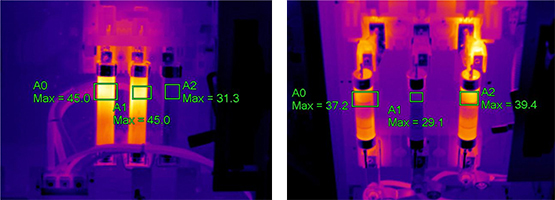
When using IR to inspect electrical systems, it’s good to keep in mind that the faults we’re looking for aren’t always what’s hot. Sometimes it can be the components that appear cool that are the problem.

Photo of pumps in operation.

Motor Talk

Stepper Motors can Benefit from Motor Testing

One of the more common questions asked by reliability workers with regard to Electric Motor Testing (EMT) is the type of electric motors that can benefit from condition monitoring testing. Obviously, various industries employ different sizes and types of motors. Some facilities would consider a 25HP motor to be enormous, while others have 250HP plus higher motors, and still, other facilities might only employ fractional horsepower motors. Sometimes overlooked as a candidate for EMT inspection are servos and stepper motors.

Buildings

When to Perform Building Inspections

When performing a conduction inspection on a building many of the thermal patterns detected can be deceiving. Misinterpretation of patterns can be caused by a variety of factors, including (but not limited to) solar loading and soffit/eaves shading.

Motor Talk

Power Quality is an Important Step

We’re often asked why power quality is a part of an online (energized) motor test. It is important to understand that the PQ test of an energized motor test is only a snapshot of the overall power quality present at that motor. If a facility suspects they have widespread power quality issues, an energized motor test isn’t going to give them all the answers they need. We can provide a deeper, more comprehensive power quality analysis if that’s what’s needed.

Buildings

How Effective is Your Insulation?

Industry specific euphemisms can be incredibly humorous. There are a variety of air brake switches in substations that linemen often call “popsicles”, for example. A tangle of wires is commonly called a “bird’s nest”. In building science there is a component used to help install fiberglass batt insulation called “Tiger’s teeth”, and if you are not using them, you might be causing the insulation system to be less effective.

IR Talk

5 Tips for Managing Your Inspection Program

At The Snell Group, we enjoy meeting new people, talking about IR thermography and all of its various applications, and assisting students when they get back to their respective facilities after class. However, one of the more common things we see is the expectation that having attended a Level I, or even a Level II, IR course empowers the student to administer and manage a full inspection program. It will take more than that.

Motor Talk

Why is Insulation Temperature Correction Important

One of the most widely known test methods applied to electric motors is the resistance to ground (RTG) test. It is commonly referred to as a “megger” test, because one of the meg-ohmmeter manufacturers, Biddle, named their product a “Megger,” and the name stuck. Biddle is now called Megger. Resistance to ground testing can be performed by standalone instruments and is incorporated in types of equipment that provide comprehensive motor testing as part of their suite of tests.

Buildings

Consider Optional Lens for Building Inspections

While an infrared camera’s standard lens is likely fine for most circumstances, the option to add a telephoto or wide-angle lens can prove useful in certain aspects of building inspections. First, if you are new to infrared and think you might have the need for an optional lens, know that not all camera models are designed to support that feature.  This is an important consideration when budgeting for the purchase of a new infrared camera. Know what camera models provide that option and know how much to budget for this added feature.