Training Schedule
Training for Infrared and EMT professionals world-wide.

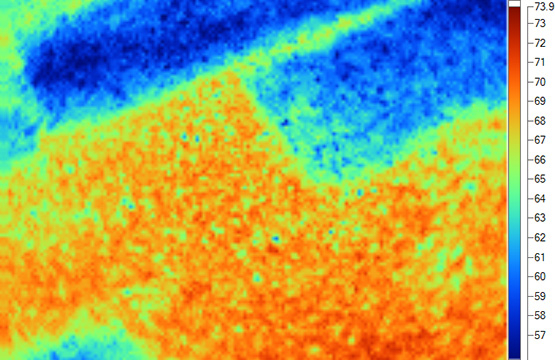
There are millions of low-slope (flat) roofs in the US, mainly on commercial buildings, and many of them have much shorter life spans than they should. One reason for this is lack of maintenance and regular inspections. IR is a wonderful tool for performing roof inspections to determine the presence of moisture in the insulation under the roof membrane. However, to perform an effective roof inspection using IR, it is crucial to have the right environmental conditions. In this month’s tip, we will discuss the environmental conditions needed to perform a roof moisture inspection. (For more information on this subject, consult ASTM Standard C1153.)
The best time of day for performing a roof moisture inspection with IR is typically about an hour after sunset on a sunny day. The roof surface must be dry and you need a clear night with little or no wind. The reason these conditions are so important is that without them, we won’t see the thermal patterns that we’re trying to detect. During a sunny day, the solar radiation heats up the entire roof, making daytime impossible for inspections as the entire roof will appear warm. After the sun sets, any wet insulation will hold the sun’s heat longer than the dry insulation due to the high thermal capacitance of water. With the right conditions, you will see that temperature difference on the roof surface with your thermal imager. If the roof surface is wet, evaporative cooling can mask this signature. If there is too much wind, convective cooling will mask the signatures. If the conditions are wet AND windy, then you’ve got evaporative and convective cooling both working against you. In northern climes, winter inspections can be impossible due to the presence of snow on the roof. If you do not have direct line of sight to the roof membrane or ballast because it’s covered in snow, you will not be able to inspect it.
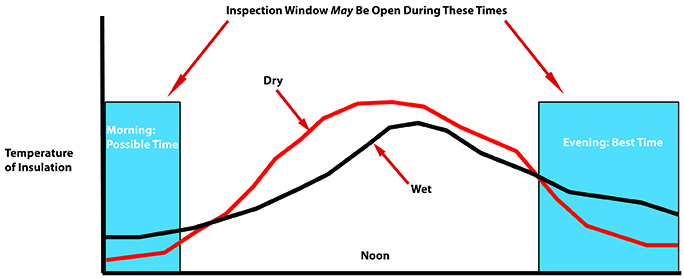
On cloudy days the roof may not heat up enough to produce the thermal signatures that we’re looking for. Inspections can be done on cloudy evenings, but it may take longer for the signatures to appear because it will take longer for the dry areas to cool off. So, instead of an hour or so after sunset, it may take 2 to 3 hours after sunset before the thermal patterns appear. The clouds minimize radiational cooling, which means the ambient conditions have to provide the cooling necessary for us to see thermal patterns. So, a summer night that stays warm can make inspections difficult or impossible. You will have a limited amount of time after sunset to perform your inspection. At some point, even the wet insulation will cool off to the point that the entire roof looks the same when viewed through your thermal imager.
The right environmental conditions are critical to ensure an effective roof moisture inspection. If you show up to perform a roof moisture inspection on the scheduled date and the conditions aren’t right, you don’t have much choice other than to re-schedule the inspection. Otherwise you will be wasting your time and the client’s time. As long as you can clearly explain the importance of the right conditions to the building owner or client, they will usually be more willing to re-schedule the inspection. Hopefully, this tip gives you the knowledge to be able to do that.


