Training Schedule
Training for Infrared and EMT professionals world-wide.

My recent experiences out in the field seem to indicate that more and more facilities are now compliant with the NEC Article 110.16 requirement for arc flash labels. While this is a good thing, I am concerned that there might be some confusion regarding the wording used on some labels.
There is some content standardization, but not all labels are alike. A few contain so much data that it is hard to separate what is important vs. what is not. Others seem to list only small bits of information while leaving the supposed “qualified person” in the dark with respect to some of the important details.
The NEC requirement I mentioned above is for labeling, but it does not address content. NFPA-70E goes a bit further and in Article 130.3(H) states “… shall be marked with a label containing all the following information: (1) Nominal System Voltage (2) Arc Flash Boundary (3) At least one of the following: (a) Available incident energy and the corresponding working distance, of the arc flash PPE category in Table 130.7(C)(15)(a) or Table 130.7(C)(15)(b) for the equipment, but not both (b) Minimum arc rating of clothing (c) Site specific level of PPE”. I try to consider most everything from the perspective of being in the field, so a label containing only the incident energy might not be comprehensive enough. It is possible that some qualified persons may not immediately know what level of PPE is required for an Incident Energy of 4.6 Cal/cm2. So for my money, having the PPE level on the label helps. Generally speaking, more information is better in this realm.
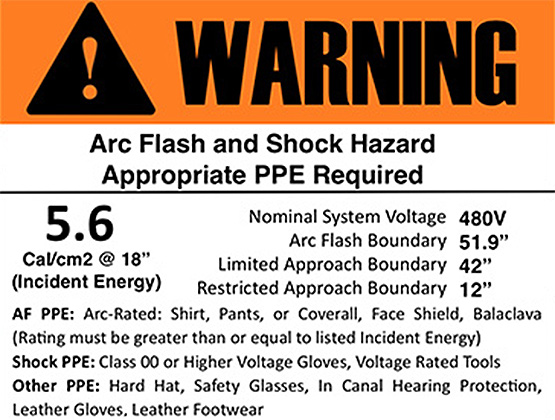
Let’s take a look at one example. Here we see a label with an abundance of data. So much in fact, that if one is not arc flash analysis savvy, they might become lost. Here is a breakdown of the included information:
Working Distance: Very important. The IEEE Standard 1584 allows for calculation of incident energies at a working distance of 18 to 24 inches for 600VAC class equipment. The working distance is an important figure because that is the distance a technician’s torso would be from the source of the arc should they be interfacing with the equipment. It is imperative for the purposes of safety that the qualified electrical person know the working distance and not encroach any further unless additional PPE is applied. The shorter the working distance, the higher the incident energy to which a worker would be exposed. For this reason, many arc flash assessment providers will default to 18 inches for 600VAC Class equipment for an added margin of safety.
Arc Flash Boundary: This is the distance from the source of the arcing fault at which the incident energy falls below 1.2 Cal/cm2, the threshold for a 2nd degree burn. Qualified persons who are within this boundary while the equipment is exposed and energized need to be adorned in the PPE appropriate for the equipment in question.
Incident Energy at 18 Inches: This is the amount of heat to which one would be exposed at the working distance in the event of an arcing fault. It is the value that determines the level of PPE. Arc flash PPE is intended to reduce the effects of the energy to which the worker is exposed and to mitigate the effects of a 2nd degree burn. The Arcing Thermal Performance Value (ATPV) of the PPE applied for a device should be at or above this level (measured in Cal/cm2).
PPE Level: The most important data point. “What do I have to wear to expose this equipment for inspection?” In this case it is HRC-4, which is a 40 calorie arc flash suit (or alternately pants and jacket combo, as well as a “bee keeper” hood, safety glasses, hearing protection and 40 calorie gloves.
Ultimately, the best course of action is to spend some time reading the 2018 NFPA-70E to increase your arc flash awareness. There are still many facilities out there today with generic labels that contain no data at all, but instead encourage you to “Consult the NFPA-70E”. When you see a label, and you are not sure, it never hurts to ask. They are there for our protection, so let’s all learn to use them in the best way possible.


