Training Schedule
Training for Infrared and EMT professionals world-wide.

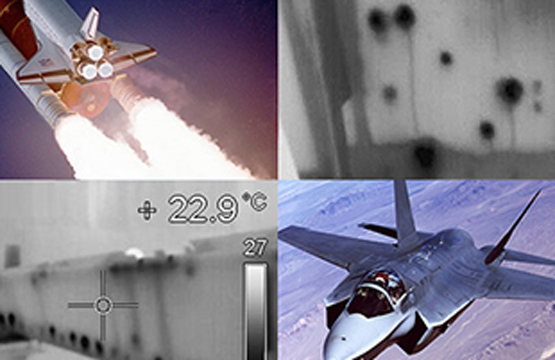
The adage, “There’s more than one way to skin a cat,” is true when identifying fluid/water ingress into metallic and composite honeycomb sandwich parts. Airbus, Boeing and our military, for example, have developed and integrated many different inspection procedures utilizing infrared thermography. Each of these techniques takes advantage of the thermal/heat capacitance of water for NDT testing.
Inspection conditions and accessibility will usually dictate the approach used. In the case of elevators, rudders and blades, the first decision will be whether to inspect in place or to remove the part. Site and manufacturer’s procedures will establish the approach to be used.
One thing each of the procedures is based on is the high thermal capacitance of water/liquids. Thermal capacitance, or heat capacity, is the product of a materials specific heat and its density. Among common materials, air has one of the lowest heat capacities and water one of the highest. The thermal capacitance of water is over 3500 times greater than that of air. This material property equates to areas with high heat capacity being slower to change temperatures than areas with low heat capacitance. So honeycomb, whether aluminum or Nomex, core filled with water will change temperatures much slower that areas of dry/air filled honeycomb. This results in different surface temperatures when the component is forced out of thermal equilibrium. This can be accomplished by warming up a cold or ambient part, or conversely by cooling off a warm part.
We must remember infrared cameras detect infrared radiation leaving a surface. As we heat up or cool off a part a predictable thermal pattern is generated on the surface. Subsurface features such as structural variations, patches, excessive adhesive or water disrupt the normal heat diffusion and allow us to infer a subsurface feature or artifact.
Environmental and surface conditions can have a tremendous effect on the technique selected and its success. Be sure to remove loose paint, dirt or grease from the surface of the inspection area. Ensure the effects of solar loading, paint/decal schemes or convection from wind or fans are minimized. Even a light breeze can many times erase subtle surface thermal patterns. High or low ambient temperatures can also create inspection issues. For example, if the ambient temperatures are extremely high, adding heat to a surface with a heating blanket, quartz lamp, or heat gun may not induce enough heat transfer to produce thermal patterns we are looking for on the surface of the part.
Let’s look closer at some of the specific techniques used to identify areas of possible water ingress in the honeycomb on aircraft rudders and elevators. Keep in mind we must “disturb the peace” by forcing the component out of thermal equilibrium. Several approaches can be used to accomplish this. First the component can be heated up or cooled off from ambient for a period of time by flying at altitude, placing a heating blanket over it or putting it in an oven or refrigerator. Then while the part is returning to thermal equilibrium with its surroundings, heat transfer is initiated. Another approach is more direct where heat is added to a component in the form of a hot air gun or heat lamp and the part is inspected during this transfer of heat. Or lastly, a component could be cooled from ambient with a water mist or cool air convection. Each of these techniques will create a temperature difference between honeycomb cells with water and cells that are dry. This thermal pattern may then be visible on the skin or surface of the part, where with an infrared camera, we can identify areas of suspect water ingress.
Infrared cameras used for these techniques must have adequate thermal sensitivity and spatial resolution to identify the thermal anomalies. The thermographer must be able to efficiently operate the camera to optimize the thermal level and span in order to emphasize the temperature difference between wet and dry honeycomb cells. An understanding of emissivity variations (along with the specular nature of some aerospace materials) on the surface and how they affect infrared images, and controlling or minimizing the influence of the inspection environment, are crucial to the success of all infrared testing – NDT testing is no exception.
Many procedures utilize an assistant, or remote sensors, to measure skin temperatures with a thermocouple to assure adequate heating prior to infrared testing. Areas can then be marked and/or imaged for reporting purposes. Additional testing may be required to verify the presence of water. X-ray or a coin tap are required by some inspection procedures to identify areas where a patch, excessive adhesive, or subsurface structure may appear thermally similar to water with an infrared camera. Flash or pulse thermography can be utilized as a more definitive method for detection of the presence of moisture but more on that in a future tip.
ASNT SNT-TC-1A, NAS 410 and ATA Spec. 105 will define technician qualification/certification requirements necessary for this testing. Regardless of which one of these governs your programs; training, testing and experience will be required. Our Level I and Level II NDT training products cover water ingress testing, as well as all three certification schemes and documentation needed for NDT programs.


