Training Schedule
Training for Infrared and EMT professionals world-wide.

Various building materials require different amounts of heat energy to reach the same temperature when a transient event occurs. Or said another way, wood, concrete and insulation all react differently to temperature changes (whether heating up or cooling down) thanks to differences in the thermal capacitance of those materials (we will not address water in structures and its effects in this tip). Thermal capacitance is the amount of heat energy required to raise a volume of a material a specified temperature (i.e. the amount of heat energy required to raise one cubic foot of a material by one degree). It is based on the specific heat of a material and its density.
During an infrared building inspection, the thermal signatures we see on surfaces, inside and outside, are often affected by these differences in thermal capacitance of the building materials used in the construction of the wall. In a number of instances this can create confusing, and often misleading, thermal patterns during both warm and cold weather inspections, especially when solar loading is involved. That is why an infrared building inspection standard such as ASTM C 1060 directly addresses the effects of solar loading as it can significantly impact what you will see thermally.
According to C 1060, the effects of solar loading will last for up to three hours on light frame (wood) buildings and as much as eight hours on masonry structures. That is the amount of time recommended for direct sun to be off of a surface before conducting an infrared inspection. So why the suggested wait time?
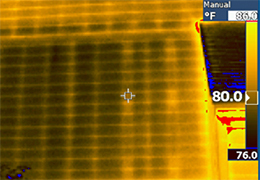 Let’s look at this example captured on the outside of a wood-frame building during warm weather conditions (cooler on the inside) where the framing members appear to be relatively warmer than the cavities. This is a classic pattern of what an uninsulated wall looks like in warm-weather from the exterior; however, the wall is in fact insulated. The relatively higher thermal capacitance of the wood framing is another possible explanation of why we are seeing this particular thermal pattern.
In this case the sun had thermally charged the wall surface for a better part of the day. As heat energy was absorbed by the structure, the wood studs took on more of it, taking longer to warm up than the adjacent cavities. Once the sun left the surface and the wall started to cool off, the framing, containing more heat than the cavities, took longer to cool off because it had more energy to give up. The result? We see this lag in that the studs are warmer because they are still in a transient state after having been thermally charged by the sun. However, if you did not realize this, and happened to show up at this exact moment when the sun was off the wall, you might have incorrectly stated that the wall appears to be uninsulated.
So watch out for the impact that thermal capacitance may have on your next infrared building inspection. Be sure to remember how long the effects of solar loading can last on different types of building materials. Keep in mind what that means not only to you as a thermographer trying to diagnose missing insulation in a wall, but also your business in terms of scheduling the most appropriate time for your next infrared job.


