Training Schedule
Training for Infrared and EMT professionals world-wide.

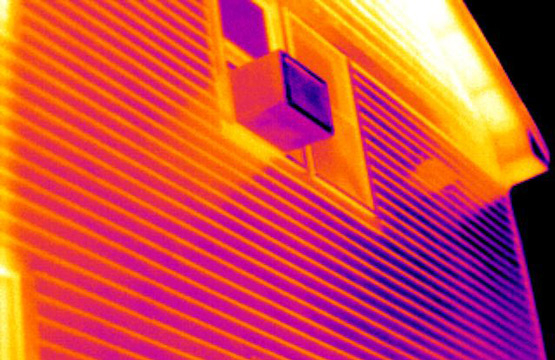
This month we would like to address a reflectivity challenge that building thermographers will encounter; this one regarding how the thermal signature of wood or vinyl siding can vary depending on your angle of view.
Even though most painted wood or vinyl surfaces have a low thermal reflectivity, this is still only true if you are viewing them from a perpendicular position. As your angle of view increases, so does the reflectivity of the surface you are inspecting, regardless of how emissive it might be. This can be clearly seen in the image above.
The right side of the wall (painted wood siding) on the exterior of this building appears to be cooler than the left when actually the entire wall is the same temperature. What we are seeing on the right is instead a reflection from the sky, thanks to the steep angle of view and the relatively colder background.
This is a good example of why building thermographers should try and keep their inspection angle as close to perpendicular as possible or at least minimize this to the best of their ability. Unfortunately, as we will see in the next example, doing so is not always very easy.
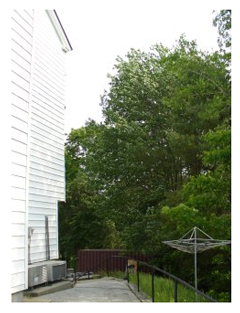
During a recent infrared inspection of a large residential facility, we encountered sections of the building that were only about 15-20 feet from the top edge of a steep, heavily wooded, slope (Image 2). Inspecting the upper floors from this elevation proved to be next to impossible as the angle of view was too great, and we could not back up far enough.
As a result, the upper portions of the wall (white vinyl siding) appeared to be cooler than the lower section even though it was likely the same temperature throughout (Image 3). You can also see a thin vertical warmer reflection of the adjacent wall on the left. Aside from climbing one of the trees (which I wasn’t about to attempt) or renting a scissor lift (which we couldn’t have gotten up there anyway), there’s not much else you can do in this particular situation from the outside.
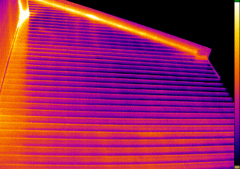
Ultimately, building thermographers need to be aware of these reflectivity issues when it comes to angle of view and attempt to minimize the impact it can have on their inspection. When that is not possible, be sure to note these differences in your report and try to troubleshoot them as best as possible, knowing that you might not always be able to find a workable solution, at least from the outside.


