Training Schedule
Training for Infrared and EMT professionals world-wide.

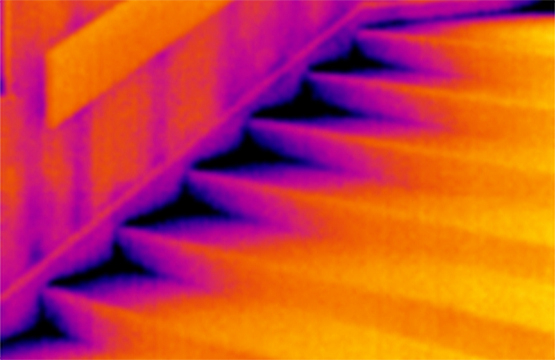
Cold air infiltration detected passing into this staircase from an exterior wall. This pattern was not present prior to running the blower door.
Besides its obvious contribution to heat loss and energy use, excessive air leakage in a building can also create moisture problems and, in cold climates, frozen pipes. With infrared we can detect air leakage pathways in and around a building and see surfaces change temperature where air movement is present. While this work can be done well under natural pressure differences, it is usually better to control and enhance the air movement pattern through the use of a blower door.
When qualified to do so, working with a blower door can help a building thermographer better identify areas of air leakage that may not necessarily show up under natural pressure conditions. Depressurizing a residential home to 20 Pascals may be sufficient to detect the effects of air leakage from inside a building. Direct leakage pathways will show up within minutes, while those that are more indirect may take longer or need additional depressurization.
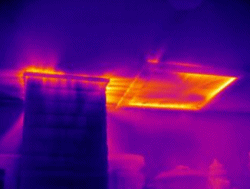
Running a blower door to detect air leakage is always done after checking the building for insulation voids. That way any air movement in the wall cavity is minimized, allowing the thermographer to more easily discern thermal patterns that represent areas of missing insulation. Once a door is up and running (depending on the insulation type and how leaky the building may be) any air movement can potentially mask insulation patterns that were present on the wall prior to running the fan.
Using a blower door is relatively simple, however, it should never be attempted without proper training and an acute understanding of the building systems and insulation materials that are in place. It is the responsibility of the operator to know when it is safe to run a blower door and when its use should be avoided. Due to significant safety issues, such as pilot lights, it is the responsibility of the operator to utilize effective procedures or protocol and to know when it is safe and the conditions are correct to run a blower door and when its use should be avoided. When the conditions are right, though, the information gathered from the operation of a blower door will be invaluable to that of the building thermographer, facilitating their work and allowing for a more thorough inspection of a home.


