Training Schedule
Training for Infrared and EMT professionals world-wide.


To be successful at testing electric motors and their associated circuitry, it is important that you understand the type of starting circuit the motor is utilizing. You should understand the purpose, how it is going to affect starting current, start duration, and the data acquired. You also should be aware of the hazards involved with testing differing types of starting circuits.
Engineers have long used differing methods to reduce starting current. Particularly with low voltage high horsepower motors, starting currents can reach thousands of amps. Here we will discuss two less common types of “Series Impedance Reduced Voltage Start” configurations. This type of starting circuit employs either additional resistance or inductance in series with the motor windings during start. These impedances drop out after a few seconds. The increase in impedance reduces voltage and less current is drawn during starting. These types of start circuits are employed on systems less than 1000V.
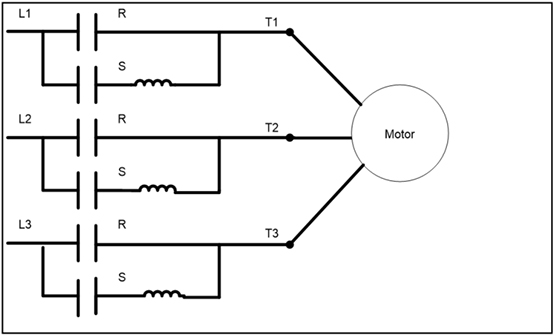
A low voltage start circuit can develop 2-10 times the full load amperage rating of the motor during starting. So, for example a 480V 450 horsepower with a FLA of 485 amps could develop 4,850 starting amps. A relatively inexpensive way to greatly reduce starting current is to place more impedance in the start circuit in series with the motor stator windings. This will drop voltage across the series impedance and reduce the current while the start circuit is connected. A time delay relay is employed to switch from “Start” to “Run.”
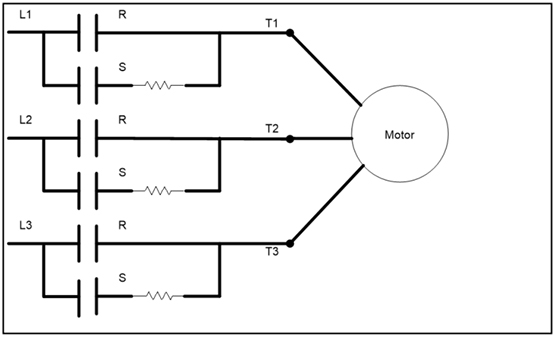
With the development of VFD’s these circuits have become quite rare, but are still around. It is recommended that these be tested during start on each phase to ensure balanced current is present in all 3 phases. A 6-channel monitoring capability would be ideal as 3 phase current and voltage may be simultaneously captured.
These circuits reduce the voltage and current sensed by the motor during the start period. Because of the reduced voltage the transition to runtime will be affected proportional to the amount of voltage dropped across the series impedances.


