Training Schedule
Training for Infrared and EMT professionals world-wide.

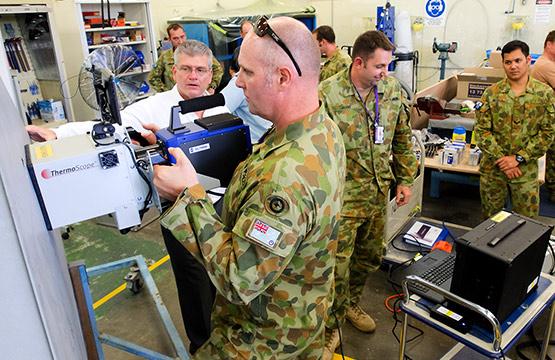
One of the many principles of successfully conducting thermal NDT on components is that the thermographer must consider—and sometimes control—the external environmental influences on the materials they are inspecting. These influencers may directly affect the thermal equilibrium of the part and/or its surface, and this may have an effect on the quality of the data collected for analysis.
A few examples to consider include ambient temperatures, wind/convection, moisture, variable thermal backgrounds, internal exothermic or endothermic reactions, surface thermal emissivity and its optical absorptivity as well as thermal flux if the object is responding to the changing external and/or internal thermal variances.
Specific examples we have encountered include:
Without taking these variables into account, or better yet controlling them when inspecting components, it may prove difficult to differentiate between actual flaws and false positives. If the thermographer is using a pulse thermography hood/flash lamp configuration with the infrared camera, the hood may shield the component from extraneous hot or cold sources, thus minimizing or eliminating many of these issues. Care must still be taken, especially on parts with curvature or challenging geometries or configurations.
If you have a portable infrared camera available to you, a quick scan around the entire work area before starting to inspect a component may show you possible external thermal sources that must be accounted for or shielded during inspection. Also remember that if the part orientation is changed during inspection, or the thermographer changes their inspection angles at all to look at the material, different sources of extraneous thermal radiation may be reflecting off the surface that did not appear earlier stages of the inspection.


