Training Schedule
Training for Infrared and EMT professionals world-wide.

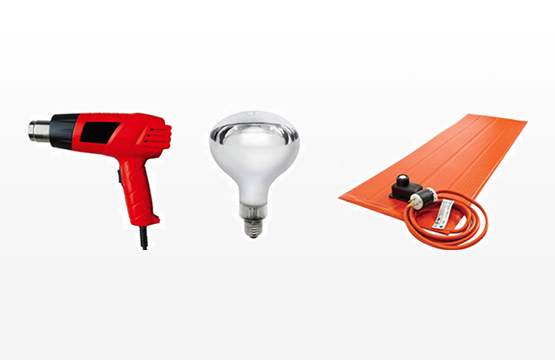
If you are conducting NDT testing utilizing infrared thermography expect to be accused of “disturbing the peace”. Why, you might ask? Fair question, and the answer is; there is a constant transfer of energy between all objects and their surroundings. If an object is giving and receiving energy at the same rate, then the object is in thermal equilibrium with its surroundings. Without external excitation all objects tend to move toward equilibrium. This is fine for many infrared applications, but unfortunately in the NDT world, meaningful data is only produced when a part is experiencing transient heat flow.
When conducting active thermography the thermal equilibrium of the part is intentionally upset by either heating or cooling the surface. The part will want to return to thermal equilibrium internally and then with its surroundings. NDT analysis is usually conducted as the part is returning to internal thermal equilibrium. It is during this diffusion process that we observe, or capture, data from the part’s surface, where internal defects disrupt normal heat diffusion and conductive heat transfer. One of many possible infrared camera configurations may be used to capture this data, as thermography infers what is going on beneath the surface based on the surface temperature of the part being inspected.
The proper method of thermal excitation should be matched to the application’s requirements and the infrared system being utilized. For example we would not typically utilize a heat gun to identify near surface defects on a highly conductive material. The thermal signature would be over before we removed the heat source. Methods of thermal excitation can include; optical, convection, contact, acoustic, the sun, electromagnetic induction and others. These signals can be pulsed, stepped or modulated, as shown below.
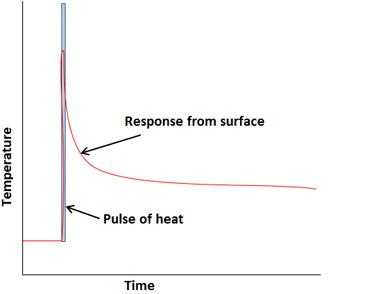
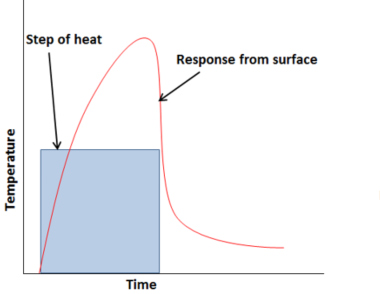
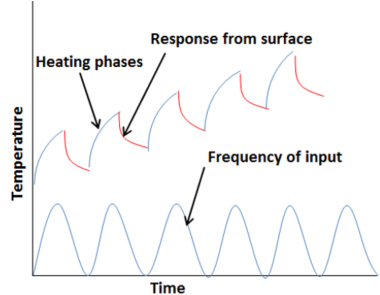
Pulse, which is sometimes called flash thermography because flash lamps are used, can be very effective for materials that have a high conductivity, or when looking for defects in the first or second plies of a composite material. These are situations when the surface response might be gone before the excitation method is complete in the other methods. Step heating can provide consistent results when materials are thermally slow or for the location of water ingress. Modulated excitation has proven effective on some thicker materials where significant heating is required to excite the part. It should be noted that the pulse and modulated heating methods may require infrared systems with integrated image processing.
The method and intensity of applying heat will depend on:
These methods can be grouped into two categories; non-contact and contact excitation.
Examples of non-contact excitation:
Examples of contact excitation:
Regardless of the method selected, care must be taken to prove that the technique is suitable for the application. For consistent results, a calibration standard should be developed to test the output of the excitation method and the input of the data collection. This standard can also be used to verify system performance for future program support. After all, it’s all about consistent probability of detection!


