Training Schedule
Training for Infrared and EMT professionals world-wide.

As the sun fails to climb very high in the sky these days, at least in the northern hemisphere, the shadows it casts can become long and influential. This is especially true on walls where an overhang can shade the upper part of a wall but not the lower. This is obvious to anyone looking at the exterior, although even there you may see, thermally, the time lag of the moving shadow (check out the multiple shades of blue in the IR image above).
On the inside, however, it is easy to forget that shading can have such a significant influence, in part because it seems so unlikely (“how can the sun affect a 4+” thick wall?!”) and partly because the effects of shading can continue to show up about 3-5 hours after the sun was on the exterior!
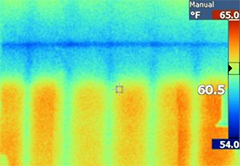 But don't kid yourself, the effects of the sun are real and, unless you are paying attention, can be very misleading. The second infrared image in this tip shows a wall that at first glance might be mistaken for having a classic thermal pattern of settled cellulose or poorly performing fiberglass. Upon closer inspection, however, we notice the framing changes temperature from top to bottom. At this point, you should ask yourself “Where was the sun a few hours ago?”
Both images were taken about an hour apart on either side of a wall that is well insulated with 3.5” of dense-packed cellulose. Remember: sometimes a wall(s) may never get sun due to shading by other buildings, trees, etc. Or, depending upon the season and your exact location, the sun may never reach a wall (ex: Vermont in the winter and a north wall).


