Training Schedule
Training for Infrared and EMT professionals world-wide.

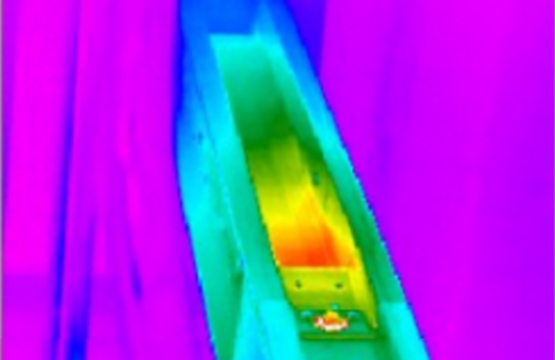
While inspecting bus duct for thermal anomalies can be challenging, it is certainly not impossible. Generally there are two types of duct that we encounter in a facility; totally enclosed or ventilated.
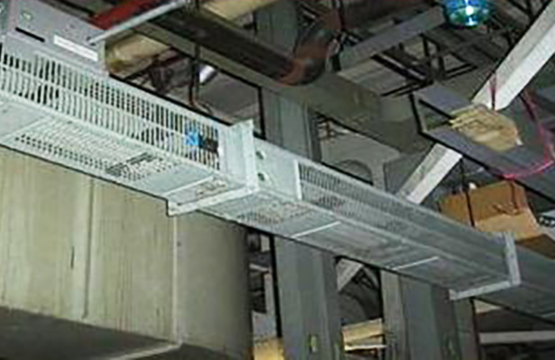
Ventilated bus duct is simply enclosed with vents or mesh in the sides to allow convective cooling to occur. These openings can make inspections easier because you have direct view of the bus itself, however you are still dealing with low-emissivity targets and potential measurement resolution issues if attempting to measure temperatures through the mesh. When it comes to enclosed bus duct, detecting anomalies can be even more challenging thanks to the large thermal gradient that exists between the surface of the duct enclosure and the point of failure on the bus. This is where care should be exercised by using a small span setting on your imager to ensure a problem has not been missed.
During IR training we spend time addressing thermal gradients and how they impact thermographers. A thermal gradient is when there is a significant thermal “disconnect” between the heating your infrared camera detects on the surface of an object and the actual point of failure inside a component. Transformers, oil-filled circuit breakers and bus ducts are good examples of equipment where large thermal gradients can exist.
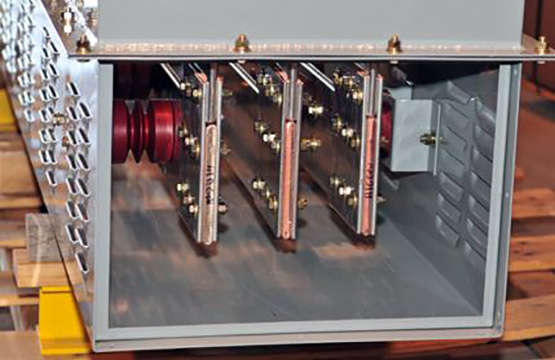
With bus duct, this gradient starts at the point of failure (where the bus bars are actually bolted together) relative to the surface of the bus bar itself. Any heat generated by a high resistance connection has to then conduct through to the bus bar surface, reducing the thermal signature in the process. Additionally bus is a massive and highly thermally conductive material that is capable of dissipating large amounts of thermal energy away from the point of failure, further dissipating thermal energy.
As this is happening, of course, the surface of the bus warms up and radiates more energy, however, since the bus material has a relatively low emissivity, the amount of radiation emitted is far less than what a more emissive surface would be at the same temperature. This reduces the amount of infrared radiation that makes it to the actual inside surface of the duct enclosure. Also, don’t forget the air gap which separates the bus from the enclosure. This gap both insulates and convectively dissipates thermal energy as well. Finally, by the time any heat makes it to the inside surface of the metal bus duct, it still has to conduct through to the outside surface. The enclosure is metal, therefore thermally conductive, so again heat is dissipated from the local heating source. Remember too that some enclosures may have a low emissivity when viewed at an angle. What all this means is that any thermal pattern detected on the outside surface often represents a far more serious problem inside at the point of failure!
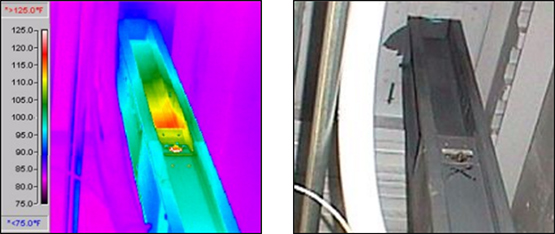
The images above are examples where a large thermal gradient existed. The apparent temperature difference (delta-T) between the anomaly and the rest of the duct surface was relatively low in this image, about 20-30°F (11-17°C). When the component was de-energized and disassembled for service, melted copper particles fell out. Copper melts at 1981°F (1,083°C)!
Besides issues with thermal gradients, know that the resolution of your infrared camera is also a consideration when inspecting bus. In some circumstances, a telephoto lens might be essential to detect and measure anomalies on bus ducts at greater distances. Another factor is angle of view. Whether a vertical or horizontal run of bus, extreme angles of view increase reflectivity issues, causing false thermal patterns to appear on the surface of bus duct that can be misleading or confusing.
Even with these considerations, bus is still effectively inspected as long as you take good care to realize all the factors to conducting an effective inspection. Even delta-Ts in the 5-10° range can indicate a severe problem exists at the point of failure. This is especially true given the high-priority nature of bus duct throughout a facility.
If you would like more information on conducting an effective bus duct inspection, we hope to see you in an upcoming Level 1 Thermographic Applications course where we talk about these and other electrical inspections in more detail.


