Training Schedule
Training for Infrared and EMT professionals world-wide.

As a thermographer, your report is your product. Your deliverable. What goes into it, what does not, the level of detail and even its aesthetics all play a part in how your daily work is perceived by your customers, your management team and your peers.;
It’s really is a balancing act. The report must be concise and inviting, but the most valuable time you spend is in the field gathering data. It is therefore essential that you work the bugs out of your reporting process to get the most out of your maintenance investment. The best way to ensure this is by first developing a boilerplate or template for your reports so that for each completed route or service visit your images and relevant data can be quickly inserted every time.
But what data is relevant? When inspecting electrical or mechanical equipment, much of what should be included in your report is spelled out in the ASTM Standard E-1934, Standard Guide for Examining Electrical and Mechanical Equipment with Infrared Thermography. Among these guidelines are some basics like the name of the thermographer, make, model and the serial number of the thermal imager used for the inspection and relevant ambient conditions of the assets being inspected.
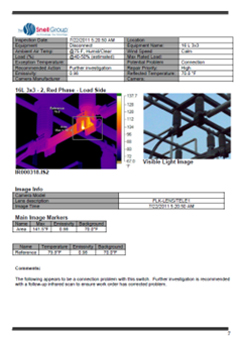
Other factors such as the system conditions, equipment ID or nomenclature, as well as any assets not inspected due to operational cycle or accessibility should also be included. You should also include the imager settings such as emissivity and background values as well as a section where follow up maintenance actions can be documented. Of course, do not forget a well written, and legally vetted, disclaimer should you be an outside contractor providing IR inspection services to a facility.
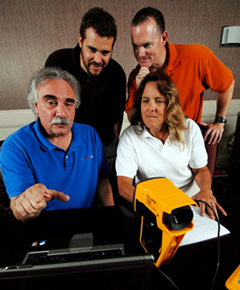
Consideration should also be given to the end-user of your report as the recipient may not know anything about thermography. If so, the thermographer may need to educate the report end-user about the entire process. The uninitiated often have unrealistic expectations of the technology and explaining the limitations often enhances the credibility of the inspection process as well as the thermographer!
Including a list of definitions is always a good idea. An Executive Summary, outlining the inspection results can go a long way too. These are all components of the report that can be part of a template that is used repeatedly, streamlining the report generation process as your time is better spent in the field gathering data. Leave the report pages clean, with plenty of white space left on the paper. In the top corner have a spot for the “W’s”; who, what, where, when why and how.
High-quality images are a must, of course. Many cameras today also have an internal visual light camera, but make sure you are capturing sufficient contrast with the internal camera. Always look at the infrared image captured before moving on to the next piece of equipment making sure focus and perspective is right. Visual images are invaluable for the technician executing the work order so they can more easily pinpoint which phase or component is running warm.
Give some thought as well to report delivery. Often customers like to have a hard copy of the report. If you distribute electronic copies, make sure you lock them or save them in a format that is tough to tamper with such as a PDF document. If you are a full-time in-plant thermographer, copies might be needed by key personnel outside of the PdM/CBM realm. If so, make certain that some time is spent helping them understand the technology.
One important thing that must be considered is the type of report that will be delivered. For example, on an exception report, only the images that were deemed to be consistent with a thermal anomaly will be included in the report. This means that all the other IR images that were deemed to be consistent with a ‘normal’ thermal signature will not be included in the report. On an exception report, it could be important to include an asset list indicating all the equipment inspected, and also, all the equipment that we didn’t have access to or that was offline or locked out during the inspection. Including all the IR images from all the equipment inspected on the report could translate into very long and many hours to create the report.
At the end of the day your report is what you have to show for all your work. If your thermography program is not yielding the type of results you would like to see, the reporting format is a good place to start improving. Good luck, and remember to Think Thermally!®


