Training Schedule
Training for Infrared and EMT professionals world-wide.

Welcome back! Last month we began discussing reflectivity and its impact on a successful inspection. This month we will continue that discussion, along with emissivity, camera limitations, and strategies for inspecting low E surfaces.
Mechanical equipment in most food processing facilities is highly reflective due to the fact that it’s made of stainless steel. These surfaces must stay clean and sanitary because of the application. Not only do you need to try and control the background as much as possible by using cardboard or other materials, many times you will also need to raise the emissivity of the surface itself by using materials such as food-grade oil sprayed on the target. The food-grade oil has a higher emissivity than the stainless steel and can be cleaned off easily without any contamination issues. Before using a method like this make sure the process allows it!
In many cases pipes and duct work are covered with highly reflective materials. To obtain a reliable temperature measurement off of such surfaces you can spray paint small spots on the surface, creating high emissivity targets. This method works well for checking valve positions in pipes. A painted dot on each side of a valve will help you confirm that the valve is operating properly or not. Again, you must gain on-site approval before applying targets with paint, tape or stickers!
Bearings can be difficult to inspect due the reflective surfaces of the inner race. The shafts can also be highly reflective. The image below illustrates how reflective some of these surfaces can be. The bearing on the left shows the race appearing to be 24°F cooler than the bearing housing due to its low emissivity. Also take note of how much cooler the shaft appears to be when compared to the bearings. Because the shaft is highly reflective it’s reflecting the cooler ambient air temperature.
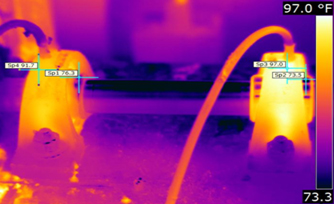
The emissivity of many surfaces on mechanical and electrical equipment can be very low, below 0.6. Many camera models available today will give you a warning stating that measurements taken with the emissivity setting in the camera adjusted below 0.6 can be unreliable and should not be used. If it can be done safely, your best option is to raise the emissivity of the target if you need to reliably measure its temperature. Emissivity values for a surface can vary widely depending on where you look, due to different levels of corrosion, dust, oil, grease, or angle of view. To get an idea of this variance, take a close look at a penny and try to figure out how many different emissivity values there are on its surface. If you don’t know the precise emissivity value of a target, how can you adjust for it? Short answer; you can’t.
Knowing your camera’s limitations and understanding the effects that reflections can have on reliable data is crucial. Reflectivity and emissivity is like a see-saw (or teeter-totter, depending where you live). Higher reflectivity equals lower emissivity and vice versa. Being able to identify reflections and reflective surfaces will help you determine which targets have high emissivity. These high emissivity targets are what you should use to improve the quality of data collected. Use these targets to your advantage. Remember, if it can be done safely, raising the emissivity of a surface by adding a high emissive target (with on-site approval) is always your best option for obtaining reliable temperature measurements from highly reflective surfaces. When you think you’ve found an anomaly, the first thing you should do is move! Be safe, and watch out for reflections!


