Training Schedule
Training for Infrared and EMT professionals world-wide.

Many times while conducting both mechanical and electrical IR surveys we are required to inspect what appears to be very reflective equipment. The lists of these types of reflective equipment are endless. A good thermographer must have the knowledge and ability to distinguish between what is a reflection and what is an actual emission on various surfaces. The general rule of thumb is “move it to prove it.” What this means is, when you spot what might be an anomaly, the first thing you should do is move your viewing angle. This will quickly prove or disprove if what you’ve spotted is an actual anomaly or is just a reflection. If it can be done safely, move a step to either side. Sometimes during an inspection, you may find yourself in a confined space with no room to maneuver. If you can’t safely take a step to one side or the other, move your camera as much as possible within safe limits. A change in camera elevation also works for this purpose. If what appeared to be an anomaly disappears, then it was just a reflection and we can move on.
Many pieces of electrical equipment such as fuse caps, buss bars, lugs, and conductors can be highly reflective and therefore very difficult to obtain reliable temperature data from. To achieve more reliable and repeatable temperature measurements from reflective parts, utilize what we refer to as cavity radiators. Cavity radiators consist of any kind of gap, crack, hole, or seam that is present. These cavity radiators are better emitters than the surrounding reflective surfaces. The deeper the hole or gap, the more reliable your temperature measurement will be.
Along with cavity radiators, look for other high emissivity targets that may be present such as insulation on conductors. With so many reflective surfaces around it can be very difficult to pinpoint where reflections are coming from. Think of a trick shot in billiards where the cue ball bounces off of all 4 walls before hitting its target. Thermal reflections can work the same way, bouncing off of multiple surfaces before we see them. Heaters, transformers, lights, your escort, you, and the ambient air temperature can all be sources of thermal reflections. By moving or changing your angle of view and using items like a piece of cardboard, we can mitigate some of the thermal reflections. For instance, you can have your escort or assistant hold up a flat piece of cardboard to isolate the surface you’re inspecting by blocking thermal reflections from other sources.
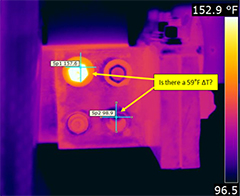 Keep in mind that thermal reflections can also be cool. In the image below we can see a set of connections 2” apart showing what appears to be a 59°F ΔT. The lower right connection was reflecting a cooler temperature from inside the enclosure. This was proved to be a reflection by moving around and controlling the background with a piece of cardboard.
Stay tuned next month for part two of Reflecting on Reflections where we will continue to discuss emissivity, reflections, and camera limitations and their impact on a successful inspection.


