Training Schedule
Training for Infrared and EMT professionals world-wide.

Over the years I've had the opportunity to conduct infrared surveys for many different companies. Each company had their own way of reporting, data collection, and what images must be taken. Some clients would only want images of any anomalies found, others wanted to establish a baseline of all equipment on the route.
It’s been said that reporting can take up to 75% more time to complete versus doing the actual route. When the company would like images taken of every piece of equipment, 75% could be a long time.
In-house thermographers typically have an advantage over outside contractors in that they should already have routes and frequencies scheduled, making organization much easier. An outside contractor may or may not have existing materials such as equipment lists to work from. If these materials are not available, or do not exist, the thermographer will first have to make a route plan for the inspection. During this stage, the thermographer (and escort/assistant) should meet with facility managers to find out what equipment they want inspected. If the thermographer is new to the trade, make sure to explain a few options for the end user's consideration. In many cases, the thermographer may be expected to "take charge" of the inspection, so be ready with a plan. Once you have this information, you can begin to plan your route.
Route planning can be done in a variety of ways. One way to plan your route is by area. This is usually the preferred choice in very large facilities. There’s no point wasting half of your inspection time by traveling back and forth across a large facility. Plot out your areas and then survey all equipment in that area before moving on.
Another way to plan your routes is by electrical service. If you’re conducting a survey in a facility that has multiple electrical services, you may want to tackle all of the equipment on service A, then move on to service B, and so on. Equipment criticality is another method of organizing routes.
After deciding on a logical system to cover the equipment at a facility and conduct your inspection, use the same system to report your findings. For example, if you use an area based system for your routes, use that same area based system to file your images and data, and to organize your report.
The more equipment a thermographer has to survey, the more images and data the thermographer is going to have to organize after the survey. This task is more easily accomplished by using a consistent method for your routes and for organizing your data.
All images, annotations, and notes will have to downloaded or transcribed after your survey. Again, when building your electronic database, your file system should mimic your route system. If I organize my routes by electrical service, I should also arrange my electronic files by electrical service. If I conduct my service by areas or rooms, I should also organize my electronic files the same way. An example is shown in the image below.
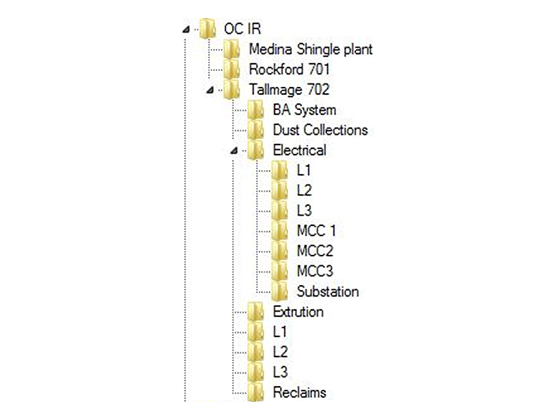
The hierarchy starts with the plant location, and then goes into sub-categories arranged by room, area, or level. The same thing can be done with electrical service, equipment type, or criticality, depending on which system you use. For in-house thermographers, a shared drive that all thermographers can access is the usual arrangement. This allows each team member access to previous reports and images, which can be extremely helpful for future inspections. The folder and file names in this hierarchy should be clear, concise, and uniform. By that I mean all thermographers sharing a directory should use the same nomenclature for file and folder names.
Join us next month for part two of Organizing Routes and Reports for Large Inspections where we will delve further into organizing reports, camera software, and shared directories.


