Training Schedule
Training for Infrared and EMT professionals world-wide.

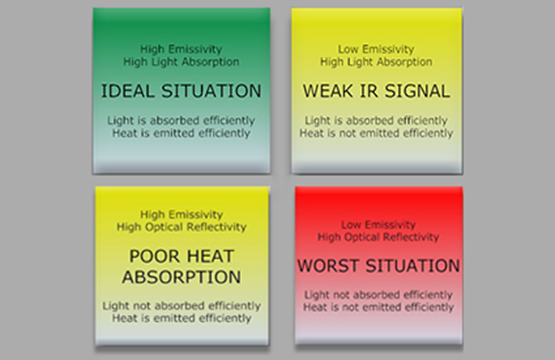
In The Snell Group’s training courses we typically teach that color doesn’t effect infrared emission on the surfaces we inspect. We do, however, warn about the effects of broadband solar radiation on dark objects.
If light energy is absorbed by an object, that energy is converted to heat energy. Objects that are dark in color absorb more frequencies of light energy than light colored objects. So, for example, an object whose surface is red to our eyes, absorbs all light frequencies except those defining red and the red color that we see is reflected energy. In the case of solar radiation, we are not limited to visible light energy. Frequencies including infrared, visible light, ultraviolet, and even small amounts of microwaves, x-rays and gamma rays are emitted by the sun. For the purpose of this discussion, we are interested in infrared and visible light frequencies.
Flash, pulse, or extended pulse thermography, involves, for the sake of this discussion, exciting the surface of a component with a pulse of light energy. The absorption of that light energy at the surface is converted to heat energy that diffuses through the volume of the material following the second law of thermodynamics. Subsurface anomalies disrupt this heat flow creating temperature differences at the surface. This signal intensity or data can be captured and analyzed in a number of ways utilizing infrared systems.
But let’s focus on getting the energy into the component being inspected. Flash lamps are an excellent method of getting energy into the component. Some advantages to the approach of producing a transient thermal event with flash lamps include the fact that they are non-contact, repeatable and the energy can be delivered very fast and efficiently. In fact, with specialty equipment, Thermal Wave Imaging’s Precision Flash Controller, it is possible to control the duration of the flash event. This minimizes the effect of any lingering flash signal that might influence the data being collected. One disadvantage is that surface preparation may be necessary. If the surface is painted a light color or is bare metal, much of the light energy will be reflected off of the surface. This may leave only a small amount of energy to be absorbed into the component. If the component is thermally slow, thick, or has a high heat capacitance there may not be enough energy absorbed to complete the diffusion process and conduct through to the back wall of the part. So, in situations like this, the surface may need to be painted or modified to be a better absorber of light energy. Flat black Crayola® Tempera washable paint works effectively to absorb light energy and also provides a highly emissive surface for data collection, utilizing an infrared camera. Note the color of the paint doesn’t affect the emissivity but it has a tremendous effect on the light energy absorption.
The graphic above describes four possible scenarios regarding the use of flash lamps to thermally excite the surface of a component for inspection. If your inspection parameters are described in the green box, you have optimized the conditions for a successful test. If your parameters fall in the red box, you will have difficulty getting energy into the component and most of the infrared signal will be reflected energy, which provides no actual thermal data about the component. If your testing parameters fall into either of the yellow boxes, proceed with extreme caution.
Surface preparation includes more than just a clean, dry surface. If flash thermography is being utilized for nondestructive testing of materials, the technician must also be aware of light energy absorption and heat emission.


