Training Schedule
Training for Infrared and EMT professionals world-wide.

When inspecting building envelopes it is important that thermographers understand the resolution capabilities of their thermal imager. That is, how much detail can they detect at a given distance with the lens and array size of their camera (i.e. their spatial resolution capabilities).
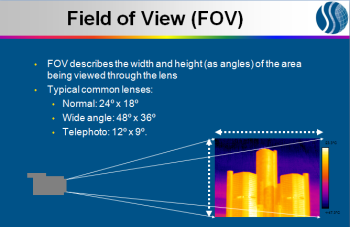 To understand spatial resolution, lets first explain Field of View (FOV). FOV is a measure of the angular view path of what an infrared camera sees. Usually measured in degrees, it determines the thermal imager’s overall viewing area and is defined by horizontal and vertical angles. The larger the angle, the bigger the field of view.
The Instantaneous Field of View (IFOV) describes the spatial resolution capability of the imager. Simply defined, IFOV is the smallest target size an infrared camera can discern at a given distance with a given lens type and detector size. It is usually specified in an imager’s technical data sheet as an angle of measurement in milliRadians or mRad. The smaller the mRad value, the narrower the viewing angle and the better the resolution of the camera (i.e. it can seesmaller objects at greater distances).
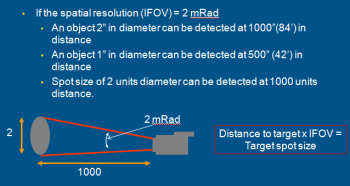 Roughly translated, an infrared camera with an IFOV of 2.0 mRad would allow you to resolve details as small as about ½” in size at a distance of about 20 feet; enough to define framing members (and cavities) in a residential building inspection.
An example of differences in spatial resolution between two different cameras is seen here with these images (below) of the same residential home, taken during cold-weather/heat loss conditions:
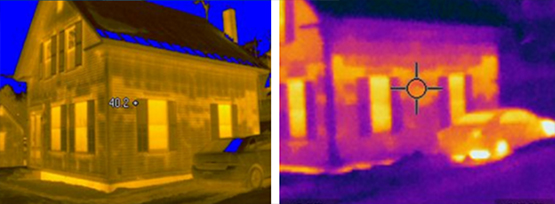
The left image above shows areas of missing cellulose, as well as the framing members, within the wall system. While we can still see larger areas of missing insulation in the image on the right, the framing members are not detected at this particular distance with this camera. It does not mean this imager cannot be used to inspect buildings (quite the contrary). What it does show though, is that to resolve framing, one must simply move closer and work within (as well as understand) the Spatial Resolution limits of their infrared system.
This example shows us that there comes a point, most often when inspecting from the exterior, where we start to reach the limit of how much detail can be resolved at a given distance with a particular array size and lens type. In other words, there are restrictions to an infrared camera’s spatial resolution capabilities which you need to understand and work within. Why? Well, consider too that smaller areas of air leakage or missing insulation can be missed if you are too far away or do not have sufficient resolution.


