Training Schedule
Training for Infrared and EMT professionals world-wide.

As building science experts know quite well, moisture trapped in the envelope of a structure creates the potential for trouble. Big trouble in some cases depending on how much is present and where it happens to be affecting the building. Moisture in insulating materials reduces its thermal resistance, resulting in increased energy use. It also degrades structural components contributing to their early failure through rot and rust. And we all know that wet surfaces are conducive to mold and mildew growth which causes health issues for occupants. When used in conjunction with a moisture meter (or a destructive test if you are qualified), thermal imaging can potentially provide good information about where moisture is affecting the building system.
Using infrared to locate moisture problems, though, is probably the most challenging aspect of the application. An IR camera alone cannot detect and confirm the presence of moisture or mold. Instead it is used to locate thermal patterns that may be associated with the presence of moisture. Even more problematic is that wet, or moist, building materials can appear to be hot OR cold, so it is essential that one understand the physics behind how these thermal patterns are created and in what type of conditions they can form.
The presence of moisture can show up thermally thanks to any combination of the following reasons:
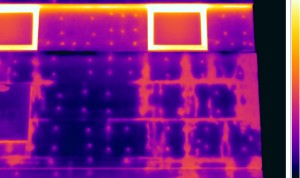 Water has about the highest thermal capacitance of pretty much any naturally occurring material. As such, it requires a lot of energy to change temperature (i.e. wet things take longer to heat up and cool down than similar dry things). What this means is that anything wet can appear to be cold as it takes longer to change temperature relative to adjacent dry materials. That same wet spot, though, after a summer day of heating where it absorbs energy, can appear to be warmer than dry areas as it contains more thermal energy as seen in this example.
Water trapped behind the stucco of this west-facing elevation on a commercial office building appears as irregularly shaped warmer areas late in the afternoon after a sunny day. These same wet spots, however, will likely appear to be cooler than surrounding dry areas early in the morning in the right conditions. Also in this image, notice how we can detect the thermal signature of the fasteners present within the wall system. They are showing up too as warmer “dots” all over the wall surface.
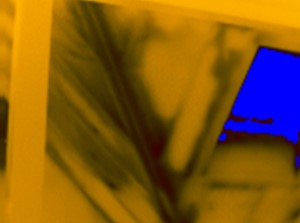 Building materials that become wet for whatever reason (whether it is insulation, wood, sheetrock, etc.) are better conductors of thermal energy than their dry counterparts. The conditions across the envelope, specifically the direction of heat flow when a temperature difference is in place, will dictate what type of pattern you may encounter.
In this example, taken from the inside during cold-weather conditions, we see a cooler thermal pattern caused by wet insulation in a valley near a skylight. There were ice dam issues in this portion of the roof which had caused water to back up and infiltrate into the roof system. Know too that missing insulation can also create a similar pattern further demonstrating that thermal imaging can have limitations in its ability to detect the presence of moisture.
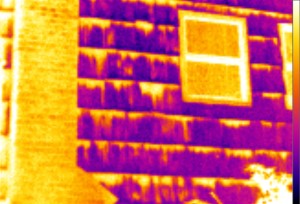 As water evaporates it cools surfaces. Any wet materials that are exposed to air will appear to be cooler than those that are dry.
This third image shows an interesting thermal pattern on the side of a residential home during the early morning hours in heat loss conditions. It looks as if there are a number of warm air leakage spots on the side of this house. What is actually happening is that it rained the previous evening and water has cooled the siding where it landed.
Even though these cedar shingles were now dry to the touch, they had undergone a temperature change where it got wet and cooled off thanks to evaporation.
Of course, timing is critical when inspecting buildings for moisture. The thermal behavior of water, and its resulting thermal signature, is both dynamic and complex. In truth, it is highly likely that two or more of these factors are causing a moisture pattern to appear. Unfortunately, using IR alone is not enough to verify that moisture is present. You will need to confirm with a complementary technology such as a moisture meter.
In any case, to ensure that you will accurately locate moisture, or to verify that there is none, the thermographer needs to understand these thermal properties of water in addition to those of building materials which the moisture may be affecting.


