Training Schedule
Training for Infrared and EMT professionals world-wide.

A quick look-up of the word “standard” in the Meriam-Webster dictionary yields the following definition:
“Something set up and established by authority as a rule for the measure of quantity, weight, extent, value, or quality.”
Standards in the workplace are rules for best practices one should (or perhaps is required to) follow to help ensure proficiency and consistency with their work. They are proper, and proven, procedures that have been tested and validated by professionals in a given field or industry so that all who execute a similar job or skill achieve consistent results (at least that is the intent).
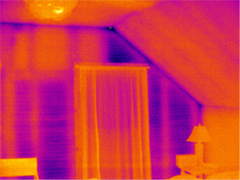 When it comes to using infrared for building inspections, there are a number of standards which are designed to do exactly that, some written better than others, that all thermographers should have an understanding of and apply in their jobs. The following is a brief summary of the standards available, some of the more important content that they include and where you can obtain them:
ASTM C 1060 – Thermographic Inspection of Insulation Installations in Envelope Cavities of Frame Buildings (www.astm.org)
This standard from the American Society for Testing and Materials details the necessary conditions, as well as many of the steps required, for qualitative evaluation of insulation performance with thermal imaging. C 1060 is where we get the 10°C/18°F, surface-to-surface (or air to air), temperature difference (for a minimum of 4 hours) needed to check for insulation performance anomalies in a building. Additionally, it also defines a few targeted equipment specifications such as thermal sensitivity and spatial resolution requirements for the thermal imager being used plus environmental considerations such as solar loading and how long a surface needs to be devoid of direct sunshine before it can be inspected (three hours light frame buildings, eight hours masonry veneer structures). It also specifies that wind speed should be less than 15mph and the surfaces be dry.
ASTM E 1186 – Air Leakage Site Detection in Building Envelopes and Air Barrier Systems (www.astm.org)
This ASTM standard is a comprehensive standard that details the necessary conditions, and proper procedures, when using infrared to locate air leakage sites in a building envelope. E 1186 states that a 5°C/9°F temperature difference is required to check for air leakage related issues in a building. A pressure difference of between 10 and 50 Pa held for a minimum of 10 minutes is suggested. Depressurization with interior scanning or pressurization with exterior scanning is permitted, and suggests that both may provide useful in determining air leakage paths. Guidance for using IR with a pressurization fan is just one portion of this overall standard which actually covers seven practices in total including using smoke tracers, air-flow measurement devices, acoustic, tracer gas, and leak detection liquids.
ISO 6781 Thermal Insulation - Qualitative Detection of Thermal Irregularities in Building Envelopes, Infrared Method * (www.iso.org)
Originally released in 1983, this standard parallels and reinforces ASTM C1060, although is somewhat more detailed and specific. It specifies that the air-air temperature drop across the building envelope shall be at least 10°C for at least 24 hours prior to investigation. Unlike ASTM C1060 it does acknowledge that testing should include evaluation of air leakage on envelope performance by producing a pressure drop across the envelope and inspecting from the low-pressure side. It also specifies a very extensive list of deliverables for the report.
Note 1: ISO 6781 has been undergoing an extensive re-write into 6 discrete parts. It will be re-titled “Performance of buildings – Detection of heat, air and moisture irregularities in buildings by infrared methods”. The original standard will be replaced by ISO 6781 Part 1: General Requirements. It will also be complemented by the release of 5 additional parts: Equipment Requirements; Personnel Qualifications; Residential Building Inspections; Commercial Buildings Inspections; and Special Applications. The first of the new amendments Part 3: Qualifications of equipment operators, data analysts and report writers was officially released in 2015 as ISO 6781-3:2015. This standard specifies the qualifications and competence requirements for personnel who (i) perform thermographic investigations on buildings, (ii) interpret the data emanating from thermographic investigations, and (iii) report the results of thermographic investigations. It provides the basis for a statement of conformity, in three classes, of the knowledge, skills, and abilities of individuals to perform thermographic measurements, analysis and reporting of results for small buildings, residential buildings, and commercial and institutional buildings. It is expected that official releases of Part 1 and Part 2 should happen in 2017.
Canadian National Master Construction Standard NMS Section 02 27 13 – Thermographic Assessment – Building Envelope (www.tpsgc-pwgsc.gc.ca)
This standard, developed by Public Works Canada, is intended to identify unexpected thermal anomalies related to thermal bridging, air leakage, missing or mal-fit insulation or moisture accumulations within the building envelope. It is intended as a guideline for the procurement of thermographic services in the commissioning of new buildings and retrofits. It differentiates between different types of construction and different methodologies for large and small buildings as well as different temperature, pressure and environmental conditions for insulation, air leakage and moisture inspections. It is a very extensive document specifying operator and report writer qualifications (fully ASNT compliant), equipment thermal and spatial detection requirements for both large and small buildings
Canadian GSB 149-GP-2MP – Manual for Thermographic Analysis of Building Enclosures (www.scc.ca)
This manual was developed as an outgrowth of the Public Works Canada, GSA, CIRTA and NAIRTA building thermography training and certification classes held in the early 1980’s. It is an extensive document relating sound buildings science theory and investigative principles to thermographic investigations of both large and small buildings. Although somewhat dated in its references to thermographic equipment it is a good foundation and reference material for any building thermographer.
So, if you are going to do building inspections, purchase, read and learn more about these standards. You should also consider Level I training that is ASNT compliant as well as additional infrared Building Specialty courses. Then go out and apply all the knowledge gained while getting experience and you should be able to be evaluate buildings using infrared thermography.


