Training Schedule
Training for Infrared and EMT professionals world-wide.

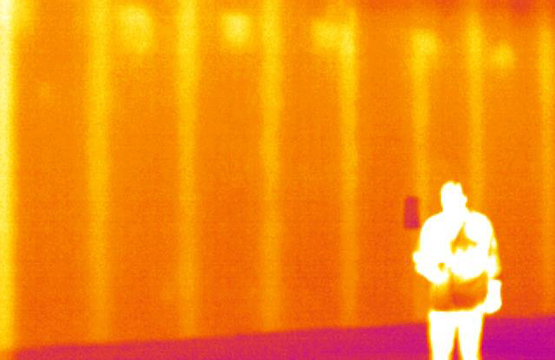
As thermographers, we know how heat flows. We can look at some objects and immediately discern the direction of heat transfer. Sometimes it is obvious which way heat is going to transfer. When we are inspecting buildings, if it cooler outside than inside the heat is going out. If the its warmer outside than inside the heat is coming in. Knowing the direction of heat flow is just part of the equation. One of my greatest difficulties, when I first was learning about building inspections, was how to determine the presence of insulation in an exterior wall. I had no problem with determining the direction, my problem is how the exterior walls should appear thermally.
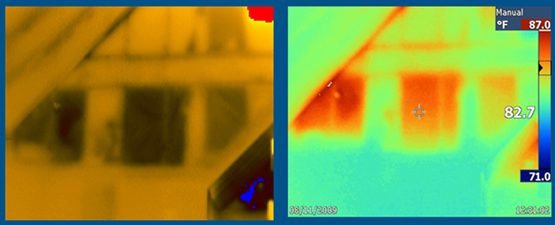
It is easy to see the difference on the above images but a little more challenging to remember why.
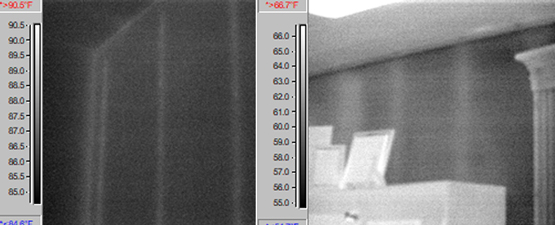
Above we have a wall that is insulated and a wall that isn’t. One is in the summer the other the winter. Guess which one represents what season. The way that I learned to remember is quite simple, but- first, let’s review some theory. The Second Law of Thermodynamics is; heat goes from hot to cold. With the theory review out of the way, imagine you are sitting in your living room on a hot summer day. It’s 70oF inside and 95oF outside.; How do you want to feel sitting in your living room on this hot summer day? You want to feel cool. If you look at your exterior walls and they appear cool compared to the outdoor ambient temperature. there is insulation present and it is performing properly. In the winter, you are sitting in your living room on a cold winter day. Its 10oF outside and 75oF inside.; How do you want to feel sitting in your living room on this cold winter day? You want to feel warm. If you look at the exterior walls and they are warm (again compared to the outdoor ambient temperature) they have insulation and it is performing properly. Another way to express this is that the walls will appear the way you want to feel inside you house at that time of year. Another way of looking at it is; if there is no insulation in the wall you are seeing the outside temperature when inside. If you are outside and there is no insulation you see the temperature inside. The lack of insulation in an exterior wall is like a thermal portal to the temperature inside or outside.


