Training Schedule
Training for Infrared and EMT professionals world-wide.

Many people, upon learning about the applicability of IR Thermography for Building Inspections, are anxious to give it a try. I know I was. I went home and inspected my house, and was aggravated by what I saw. Every time my gas bill came I got angry all over again, knowing I had multiple areas of missing or damaged insulation but unwilling to spend the money to fix it. On the other side of the coin though, when my family and I decided to relocate to a newer home, I was able to inspect it before the sale, and ask the seller to fix the few problems I found. There you have it; a happy story and a not-so-happy story about Buildings IR; opposite ends of the spectrum as it were.
Excitement and enthusiasm are good in any endeavor, but that excitement should be tempered with some restraint, particularly in Buildings IR. I had sat through a Level I IR course, had been taught what the necessary conditions for inspection were, and I still went home and ignored most of it. I was so anxious to find out how my home performed that just pointed the camera and looked. Whether your motivation is to discover the conditions of your own home, to help out a friend or family member, or to add a service to your home inspection process, you have to remember the rules and follow them.
One of the biggest things is the Delta T (ASTM C1060 delta T requirement). We teach in Level I that if we have a temperature difference from one side to the other of a solid material we will have conductive transfer. That’s what we’re largely looking for in Buildings IR. So if there’s as little as a 1°F difference, heat moves. Just because it’s moving though doesn’t mean we can detect the pattern of it moving. We need a larger Delta T, 18°F minimum inside surface to outside surface. When I inspected my house that first time I didn’t even check it. I just pointed and shot. Luckily I was able to detect patterns, but if I hadn’t detected them I may have incorrectly assumed I didn’t have issues.
Having the minimum inside-to-outside Delta T is imperative for a successful Building IR inspection, but there are other concerns as well. Solar loading occurs on surfaces even in colder weather, and can last for several hours after the sun is no longer on the surface. So it’s important to know not only where the sun is at the time of your inspection, but where it was in the hours prior to it. Also, knowing the type of insulation used in the wall systems is helpful because of the distinct patterns associated with the different types.
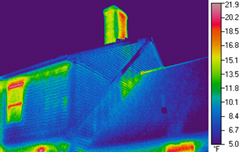
Understanding the thermal envelope of the building being inspected is also of concern. You might be surprised how many building occupants aren’t sure where the insulation starts or stops, or what parts of a building are climate controlled versus those that aren’t. It’s also important to understand the impact of air movement during the conduction inspection part of the process. Air moving across a surface can impart heat it brings with it, or take heat away from the surface it comes into contact with depending on whether it's summer or winter. It can also vary depending on whether you're inside our outside. Convective transfer of this type can mask the static patterns of the building that you’re attempting to detect.
Buildings IR inspections can be tricky due to the dynamic nature of the inspection environment, but if you follow the rules your chances of success are increased.


