Training Schedule
Training for Infrared and EMT professionals world-wide.

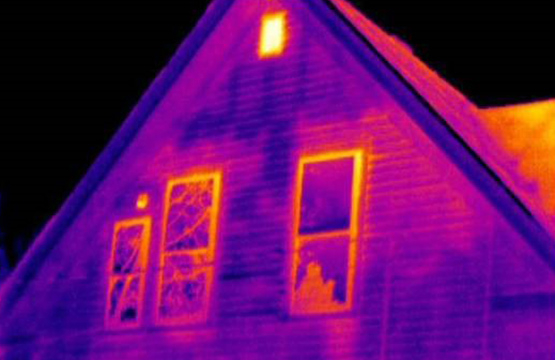
Many people, upon learning the applicability of infrared thermography for building inspections, are anxious to try it. I know I was. After taking the Level I IR course I immediately went home and inspected my house
Excitement and enthusiasm are good in any endeavor, but that excitement should be tempered with some restraint, particularly in buildings IR. Having attended a Level I IR course, I had been taught what the necessary conditions for inspection were, and I still went home and ignored most of it. I was so anxious to find out how my home performed that I just pointed the camera and started looking. Whether your motivation is to discover the conditions of your own home, to help out a friend or family member, or to add a service to your home inspection process, you have to remember the rules and follow them.
The most critical rule is the Delta T (ΔT). We teach in Level I that if there is a temperature difference from one side to the other of a solid material we will have conductive heat transfer. That’s what we’re looking for when performing an IR building inspection. With even the tiniest difference in temperatures, heat will move. However, just because heat is moving doesn’t mean we can detect its pattern. We may need a larger ΔT; 18°F (10°C) minimum inside surface to outside surface. When I inspected my house that first time I didn’t even check the ΔT. I just pointed the camera and started shooting. Luckily I was able to detect patterns, but if I hadn’t detected them I may have incorrectly assumed my home didn’t have issues.
Having the minimum inside-to-outside ΔT is imperative for a successful IR building inspection, but there are other concerns as well. Solar loading occurs on surfaces even in cold weather, and the effects can last for several hours after the sun is no longer on the surface of the building. It’s important to know not only where the sun is at the time of your inspection, but where it was in the hours prior to it. Knowing the type of insulation used in the wall systems is helpful because different types of insulation present different thermal patterns depending on the temperature of the air and the temperature of the affected surface, and when they’re missing, damaged, or have just gotten old.
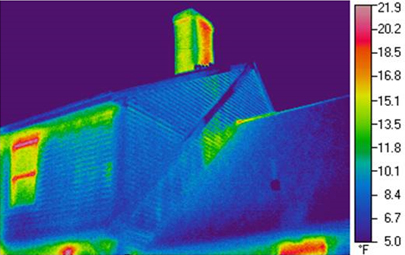
Anyone performing IR building inspections needs to understand, and be able to define, the thermal envelope of the building being inspected. You might be surprised how many building occupants aren’t sure where the insulation starts or stops, or what parts of a building are climate controlled versus those that aren’t.
A building inspection consists of two parts, the conduction inspection which looks for the presence and performance of insulation and the air leakage inspection that looks for the effects of air movement (convection in a building. Even though the conduction inspection isn't the primary means of studying convection in a building, it’s still important to understand the impact of convection during the conduction inspection. Air movement in a building can be caused by leaks in the thermal envelope, HVAC systems, wind, or a combination of these factors. Warm air moving across a surface will impart heat it brings with it, while colder air will cool the surfaces it comes into contact with. Convective heat transfer can mask the static patterns that you’re trying to detect. Another effect of convection is it can make small problems appear worse than they are, and major problems look less severe, depending on the temperature of the air and the temperature of the affected surface. Because of these effects, it may be a good idea to turn off an active HVAC or inspect on a different day if there is too much wind.
IR building inspections can be tricky due to the dynamic nature of the inspection environment, but if you follow the rules your chances of success are greatly increased.


