Training Schedule
Training for Infrared and EMT professionals world-wide.

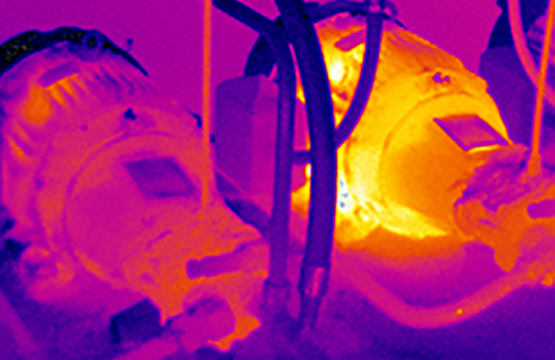
When discussing Electric Motor Testing (EMT), a question I’m often asked is, “What can it find?” On the surface, this seems to be a simple question, but when we’re talking about mechanical defects it gets a little more complicated. First, what type of EMT are we talking about? De-energized or energized?
De-energized (offline) testing does not typically reveal very many problems that would be classified as strictly mechanical. One exception utilizes the inductance measurements taken from each phase of the stator windings and compares them at different rotor positions to further define the condition of the rotor. This test is known as the Rotor Influence Check. Most of the mechanical problems detected with de-energized testing have to do with either the stator or the rotor and the relationship between the two.
Energized (online) testing can detect mechanical defects in both the motor and the driven equipment. Some doubt this, but keep one thing in mind; anything that alters the performance of the rotating field can be seen in the spectral Fast Fourier Transform (FFT) view of the current trace and the de-modulated current sample (depending on the equipment used to collect data). Mechanical defects can be found with this method if you know what to look for and which approach (or mindset) to use.
Vibration analysts look for peaks in the FFT that relate to mechanical influences to the rotational mass of the tested equipment. Imagine a perfect sphere rotating, if there are no defects whatsoever in the sphere there should be no vibration. But the sphere is rotating because of an electrical or magnetic field. This means that there is now an influence acting on the rotation of the sphere which will result in some deflection in the rotation at the frequency of the driving force. At that frequency, there will be a peak in the FFT and this peak can be measured and tracked. Vibration analysis depends on some sort of detector attached to the surface to measure this.
Energized (online) EMT uses the air gap between the stator and rotor as the same type of detector that vibration uses. But instead of acceleration and displacement, EMT uses the magnetic fluctuations across the air gap and its effect on the current signal. This means that anything that affects the rotation of the rotor will be reflected in the current signal as peak in the FFT. These peaks can be measured and tracked just as in vibration analysis but there will be a few differences. Vibration is mainly looking at the turning speed and multiples and above whereas EMT may go as high as 2X turning speed but then focuses below that down to 0Hz. Vibration has one external sensor where EMT is using as many sensors as there are poles in the motor. This results in much more sub-turning speed data collected by EMT .vs vibration analysis.
A perfect electrical motor and driven system would only have one measurable peak at 60Hz or the fundamental line frequency for the electrical system. But unfortunately, such a system does not exist. In the real world, there is always going to be an indication of something occurring that has an impact on the current signal. Our job is to figure out where those disruptions are coming from.
This is a shortlist of some of the possible causes of signal disruption (this list is not all-inclusive):
This list keeps growing as more EMT technicians are asking “what is causing that peak?” and investigating the cause. In the overall scope of condition-based monitoring evolution, EMT is one of the youngest players in the game and is still growing. Because of this newness, some people don’t trust the technology yet. There will always be some holdouts when it comes to new technologies, but this is short-sighted behavior. EMT, when performed correctly provides technicians with an invaluable trove of data that is not available through other technologies. There are many things EMT can detect and we don’t quite understand all of them yet. But we’re always getting closer!


