Training Schedule
Training for Infrared and EMT professionals world-wide.

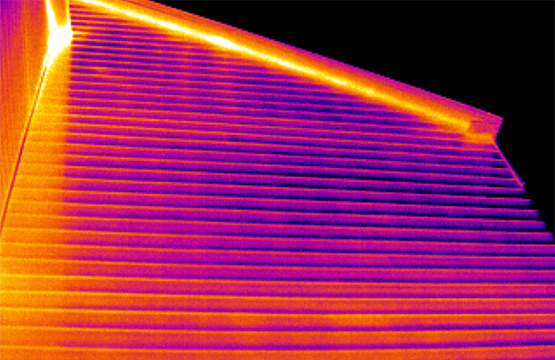
It’s always good practice to look at both sides of exterior walls when inspecting buildings if possible. However, both sides present their own difficulties. Last month we discussed a few of the difficulties you may encounter when inspecting buildings from the outside. This month we will cover a few more of those difficulties. In part one, we discussed excessive wind, moisture on walls, brick faced buildings, vinyl and aluminum siding, and angle of view. In part two, we’ll discuss solar loading, extreme temperatures, and access issues.
Solar loading occurs when the sun’s energy heats up surfaces that it is shining on and it is a year round problem. When the sun is beating down on the wall of a building, it heats up the entire wall and can quickly mask the exterior thermal signatures that show heat loss or gain. These signatures are precisely what we are trying to detect.
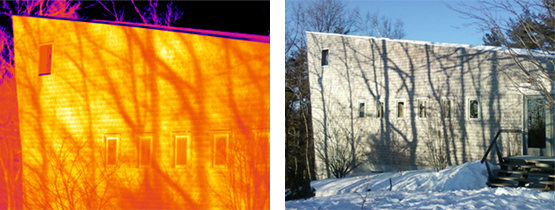
The above images illustrate the effects of solar loading on the exterior of a building and you can clearly see how difficult it is to detect any anomalies in the thermal image on the left. Another factor to consider is; what do you think the interior view of this wall is going to look like? Solar loading often results in changes to the thermal signature on the inside of the building as well as the outside by reversing the direction of heat flow from typical.
Extremely low temperatures are a difficulty that only those of us in northern climes will have to deal with, but they can have a large impact on the effectiveness of a building inspection. At extremely low temperatures there is not a lot of IR signal and many cameras perform poorly as a result. You should make sure to check your camera’s specified operating temperatures before using your camera in extremely cold temperatures. The camera’s operating temperatures address the environmental conditions that your camera can operate in, they are not the same as the temperature range that your camera can see. It is never advisable to leave your camera in your car or truck overnight, but it is especially ill-advised to do this when it’s extremely cold out.
The last difficulty we’re going to discuss is access. By this we mean access to all sides of the building, including the roof and the attic. Lack of access is a difficulty that you may not be able to do much about. Most of the other issues we’ve discussed can be mitigated or solved by rescheduling your inspection to a day or time with the right conditions. Rescheduling usually won’t help with access issues. If you can’t access a side of the house, or the roof or attic, you must report this to the building owner and let them know that your inspection will be incomplete because you were not able to inspect the parts of the building that you can’t access. However, remember that just because you cannot inspect a wall from the outside doesn’t necessarily mean you can’t inspect it from the inside.
There are many difficulties that you may encounter when performing a building inspection. But, if you understand the impact of these difficulties and know some tactics for mitigating them, they won’t slow you down too much and you can still perform an effective inspection. This knowledge will also help you explain to the building owner the need to reschedule inspections due to environmental conditions. As long as you can clearly explain your reasons why you want to reschedule, they will be much more willing to do so. A little knowledge and some “outside the box” thinking can make your job easier and your inspections more effective.


