Training Schedule
Training for Infrared and EMT professionals world-wide.

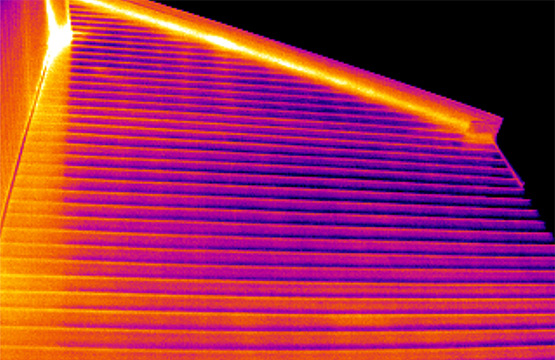
When performing a building inspection using infrared, it is always good practice to inspect both sides of the exterior walls of the building. The inside view will typically give you the most detail while the outside view will help to give you the “big picture.” Both of these views bring with them their own challenges that you may encounter. In this month’s tip we’re going to talk about some common difficulties encountered when inspecting buildings from the outside.
As we discuss in our Level 1 course, convection is a very powerful force that we must reckon with as thermographers. Excessive wind can make inspecting buildings from the exterior very difficult, if not impossible. ASTM standard C1060 states that a 15 MPH wind is the upper limit of wind speed that we can still work with. As wind blows across a surface, it will cool or heat the surface depending on the temperature of the wind verses the temperature of the surface. This can mask problems that would otherwise be evident when viewed through a thermal imager. A dry surface cannot be cooled below the ambient air temperature, but a wet surface is a different matter, which leads us to our next commonly encountered difficulty.
Moisture on walls, when combined with even a slight breeze, can allow the walls to be cooled below the ambient air temperature. This is known as evaporative cooling and can certainly mask problems by cooling the wet portion of the wall and making the thermal signatures that we are trying to detect impossible to see with our thermal imager. Moisture on walls can also confuse the thermal patterns that we’re trying to find. For example, if condensation has formed everywhere on a wall except under the soffits, those dry areas can appear warmer than the damp areas because they’re not exposed to the cold sky and the condensation hasn’t formed there yet. This can appear thermally like there is missing or settled insulation. If it has just rained, or condensation is present and the exterior of the building is covered in moisture, your best bet is to reschedule the inspection and come back when it’s dry.
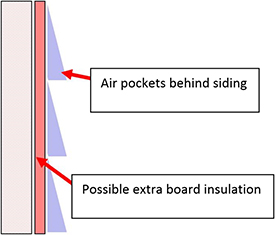
Brick faced buildings, or those with aluminum or vinyl siding present their own difficulties when inspecting from the outside. Brick faced buildings are extremely difficult to inspect from the outside and you may only be able to inspect from the interior. It is possible to inspect buildings with aluminum or vinyl siding from the exterior, but it will be difficult because the siding, like the brick, is thermally disconnected from the building due to the air gap behind the siding. Try using a narrow span and look for small temperature differences.
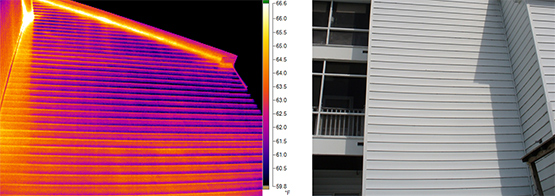
When inspecting multi-story buildings, angle of view can become an issue. In our Level 1 course we teach thermographers to work as close to perpendicular as possible because the overwhelming majority of heat emitted from a surface is emitted in a 120° cone perpendicular to each point on the surface. The greater the angle, the more reflections will come into play. If you’re standing on the ground looking up at a multi-story wall, the higher you look the cooler the wall will typically look through your thermal imager. This is due to the temperature of the sky reflecting off the wall with greater efficiency. Use a ladder or lift to reduce the angle of view and get closer to perpendicular to mitigate these reflected temperatures.
In these images we can see that the thermographer’s position was too extreme to adequately view much above the first floor of this building. When viewed through the thermal imager, the wall appears to get cooler the higher we view, when in fact, it’s all the same temperature. The area that appears cooler is reflecting the cold sky.
These are just some of the difficulties you may encounter when inspecting buildings from the outside. Stay tuned for next month’s newsletter for part two of Difficulties Encountered When Inspecting Buildings From the Outside.


