Training Schedule
Training for Infrared and EMT professionals world-wide.

When performing an infrared inspection of a building, thermographers always want to inspect walls from both sides whenever possible. However, on some building types, such as brick-faced, IR inspections from outside are virtually impossible and we will inspect from the interior only. Also, for warm weather building inspections thermographers will generally get the best results from the inside, as the outside walls and surfaces can appear hot due to direct sun or recent solar loading. The interior view of a building will typically provide the thermographer with the most detail as opposed to the exterior view. What all this means is that at the bare minimum, we will always inspect buildings from the interior. While not as susceptible to the whims of Mother Nature as the exterior of a building, inspecting the interior can present its own set of challenges that we may encounter. Some of these difficulties are the subject of this month’s tip.
Clutter / Furniture: Depending on the building and how long it’s been occupied thermographer’s can run into a significant amount of furniture and clutter to deal with. It’s not a realistic expectation that the homeowner will move all of the bookcases, pictures, paintings, dressers, entertainment centers etc. that line the walls of every room in the building. We are going to have to work around the majority of these obstacles.
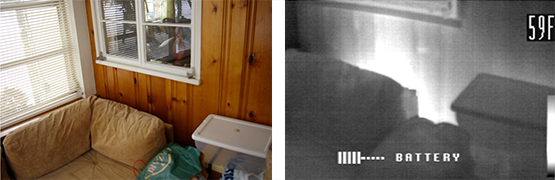
Access Issues: We may not be able to access all areas of the building to perform our inspection. The building owner may have rooms or offices that they do not wish anyone to enter for any number of reasons. If this is the case, it should be documented and noted in your report that you were not able to inspect a specific room or area of the building and cannot be held liable for missing any defects present in that room. Attics and cellars may be unsafe or too full of clutter to access them. This should also be noted in your report.
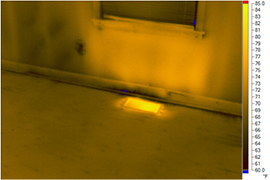
Active HVAC: Typically, the thermographer will request that the building owner turn off their HVAC system prior to starting the conduction inspection of the building. Some building owners may be reluctant to do so. This is where being able to clearly explain to the building owner why this is necessary can be invaluable. Active heating or cooling will result in confusing thermal patterns anywhere the cold or hot air is contacting surfaces. These thermal patterns can mask over defects causing thermographers to miss problem areas.
Solar Loading & Pattern Reversal: As the day progresses, the sun will hit different walls and surfaces on a building. When the sun heats these surfaces it’s called solar loading. Solar loading can occur year-round, during the winter solar it can reverse patterns and during the summer it will exaggerate them. Solar loading can quickly mask over problem areas, causing us to miss them during the inspection. Solar loading can also cause the patterns we see in a wall system to reverse over time. Examples are shown below.
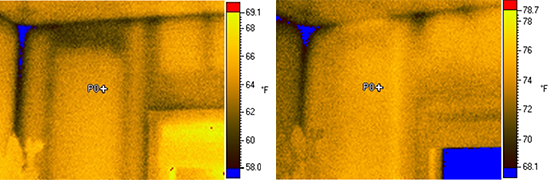
In the left hand image above, we can see a defect in the insulation in the top middle of the image. Six hours later, due to solar loading, the defect has seemingly disappeared. The defect is still there, but the wall has been heated by the sun from the outside, causing it to blend in with the rest of the wall.
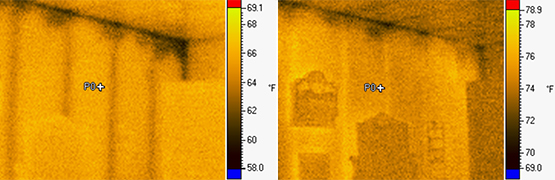
In the left hand image above, the studs appear cooler than the insulation. Six hours later, due to solar loading, the pattern has been reversed. Now the studs appear warmer than the surrounding insulation.
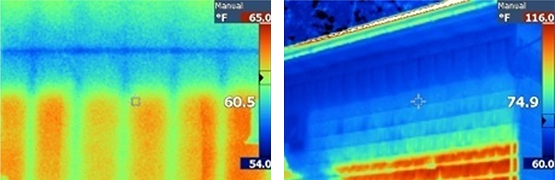
Soffit shading is another confusing pattern caused by solar loading. In right hand image above we see a wall from the exterior and the area underneath the soffit is shaded, making it appear cooler than the unshaded wall below. In the left hand image, we see the same wall from the interior. From the interior we now see a thermal pattern that could be confused with insulation defects when in fact, it’s just shading.
This list of challenges that thermographers may face is by no means inclusive, but they are some of the most common difficulties we face. Other difficulties include varying room temperatures, not understanding pressure differences and building dynamics, and defining the thermal envelope of the building. All of these difficulties illustrate the need for proper training of thermographers, especially when it comes to building inspections. Without quality training, any of these difficulties can cause an inexperienced thermographer to overlook, underestimate, or misinterpret what they’re seeing.


