Training Schedule
Training for Infrared and EMT professionals world-wide.

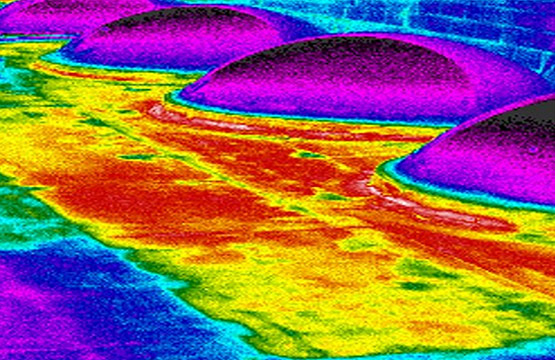
Water can be the single most destructive element that causes deterioration of materials and failure of building assemblies. It can cause or accelerate corrosion, wood-rot, adhesive dis-bond, masonry spalling, and loss of insulation R value. It is the key element present in the formation of mold and fungi that can lead to indoor air quality problems. The presence of undetected water in a building can affect the value, durability, life-cycle maintenance cost, and occupant health. The challenge facing inspectors is the thermodynamic conditions at the time of the inspection may not be conducive for that thermal detection to take place. While many inspectors have had success using thermal imaging for the otherwise undetectable presence of moisture, the question that begs to be asked is how many times has moisture been present, but since the conditions were not right, the inspector missed it.
Subsurface moisture detection can be detected by infrared thermography only when: its presence affects the surface temperature; the surface is a reliable radiant emitter (high emissivity and non-specular reflector); and the thermal camera is sensitive enough, and tuned properly by the inspector to detect such surface temperature difference. Thermographic cameras are extremely sensitive, often able to detect differences less than 0.05ºC (50mK). But while this may create a clearer, more defined pattern when the thermal conditions are right, it is not a viable substitute for moisture detection under poor conditions, when moisture is buried deep within an enclosure—especially with a low permeance surface(s), or when the surface is not a reliable radiant emitter. High sensitivity cameras used under less than ideal conditions can either lead to a large number of false positives, and/or lengthy field time for verification using other methods such as a moisture meter. False negatives lead to credibility issues of both the inspector and the thermographic industry as well as the possibilities of litigation, particularly when mold or other damage associated with moisture is present but not detected.
There are four different physical mechanisms which can cause moisture to affect surface temperature. We have already addressed two of them—evaporative phase change and condensing phase change—in Part 1 of the tip. We will now discuss the other two methods.
3. Moisture detection through increased capacitance
Many wall and roof systems have un-intentionally created two or more vapour retardant barriers which inhibits the drying process. This raises the vapor pressure within the assembly, and inhibits evaporative cooling as a means of detection. If there are absorbent materials within the enclosure (e.g. wood or glass fiber insulation) then water absorbed by these materials will increase their volumetric thermal capacitance. If the enclosure undergoes a thermal change, such as the sun shines on a roof or south wall—in the northern hemisphere—then wet areas will have a different thermal response time than dry areas (cooler sometime after the sun shines on it, and warmer sometime after the sun has been removed). On sunny days a thermographer should not ignore such thermal irregularities on east, south and west wall areas depending on the time of day. It also means that moisture detection using the capacitance method will usually not be possible on North facing walls, during the night, and on overcast days.
4. Moisture detection through increased conductivity
Absorbent insulation materials which have taken on water will have increase in thermal conductivity (decrease in R-value). If there is a temperature difference of at least 10 degrees Celsius across the enclosure this change in thermal conductivity can often be detected. This does require steady state thermal conditions (unlike thermal capacitance which requires changing conditions and does not work under steady state). The thermal conductive method of detection therefore works best in summer or winter on cloudy overcast days, or in the late evening/ early morning or any time of day on North facing walls
Summary
Thermography can play a significant role as a non-destructive and rapid screening tool to identify potential moisture related anomalies in buildings, but only if the thermodynamic conditions are right. Building thermographers who want to do moisture inspections effectively and thoroughly need to choose multiple inspection times best suited to different conditions.
Inspectors can apply a thermal camera in a limited scope for free-air detection of evaporative cooling of water related anomalies, so long as they have the proper knowledge, have a specific procedure detailing the method and conditions necessary for doing so and a means (e.g. a moisture detector) for immediate field confirmation of any suspected anomaly. They should document in their report the limitations of the technology, particularly the suitability (or lack thereof) of the conditions at the time for the detection of non-evaporative detection of moisture, particularly in exterior walls and roofs.
IR cameras suitable for building investigations are now inexpensive, lightweight and easy to use. There are, however, cameras available which do not even come close to meeting the requirements for detection of moisture anomalies. The use of infrared imaging requires training and understanding of not just the camera and infrared detection principles, but more importantly knowledge of building construction, thermal performance, and sound building science principles. The proliferation of readily available low-cost cameras used by unqualified persons unaware of the underlying thermodynamic principles, appropriate methods, and limitations however could jeopardize the legitimate value of thermography as a valuable tool for the building diagnostic industry.