Training Schedule
Training for Infrared and EMT professionals world-wide.

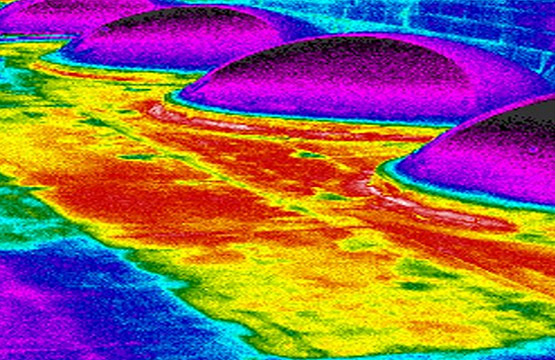
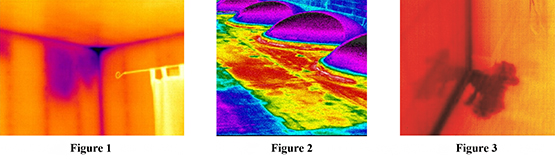
Water can be the single most destructive element that causes deterioration of materials and failure of building assemblies. It can cause or accelerate corrosion, wood-rot, adhesive dis-bond, masonry spalling, and loss of insulation R value. It is the key element present in the formation of mold and fungi that can lead to indoor air quality problems. The presence of undetected water in a building can affect the value, durability, life-cycle maintenance cost, and occupant health. The challenge facing inspectors is the thermodynamic conditions at the time of the inspection may not be conducive for that thermal detection to take place. While many inspectors have had success using thermal imaging for the otherwise undetectable presence of moisture, the question that begs to be asked is how many times has moisture been present, but since the conditions were not right, the inspector missed it.
Subsurface moisture detection can be detected by infrared thermography only when: its presence affects the surface temperature; the surface is a reliable radiant emitter (high emissivity and non-specular reflector); and the thermal camera is sensitive enough, and tuned properly by the inspector to detect such surface temperature difference. Thermographic cameras are extremely sensitive, often able to detect differences less than 0.05ºC (50mK). But while this may create a clearer, more defined pattern when the thermal conditions are right, it is not a viable substitute for moisture detection under poor conditions, when moisture is buried deep within an enclosure—especially with a low permeance surface(s), or when the surface is not a reliable radiant emitter. High sensitivity cameras used under less than ideal conditions can either lead to a large number of false positives, and/or lengthy field time for verification using other methods such as a moisture meter. False negatives lead to credibility issues of both the inspector and the thermographic industry as well as the possibilities of litigation, particularly when mold or other damage associated with moisture is present but not detected.
There are four different physical mechanisms which can cause moisture to affect surface temperature. We will address two of them in Part 1 of this tip.
1. Moisture detection through evaporative phase change
Many inspectors believe that the only mechanism for detection of moisture is evaporation. Under the right conditions, free air evaporative cooling on a surface can indeed be very thermodynamic, and easily detected with a modern infrared camera: 1 droplet of water (e.g. of a mass of 0.45gms (0.001 lbs) can theoretically extract approximately 1.05kJ (1 Btu) from the surroundings in order to provide the latent heat required for evaporation. Evaporative cooling under low relative humidity (RH) conditions however has led to two very wrong assumptions: water will always be detected by an IR camera and it will appear cool. Relying on water detection through the natural drying process only, will result both in false negatives (non-detection of moisture) and false positives (the thermal anomaly is not moisture). An infrared camera does not directly detect evaporation: rather it may detect a surface temperature depression due to the rate of evaporation. If the free air condition is warm and dry (low RH) it may create a high rate of cooling. Conversely, if the free air condition is cool and/or humid (high RH) it could easily go undetected because the evaporative cooling rate will be very low.
One evaporative cooling application that can be performed by a thermographer irrespective of the exterior environmental conditions is the potential identification of moisture sources from plumbing and HVAC equipment. This only requires that the water be present in the system, that the leak be occurring into a free air space (such as the interior ceiling joist space above the drywall, within interior uninsulated partition walls, or the flooring around showers, toilets and sinks or water using appliances.).
The irony about thermal detection of a cool surface through evaporation to free air is that the materials are often drying out, and if the source of water has stopped or is a one-time occurrence, there may not be any long-term issues.
2. Moisture detection through condensing phase change
Just as the evaporative phase change can be a very dramatic endothermic process, the condensation of water vapour back to water can be just as dramatic exothermic process. If condensation is occurring within a wall behind a vapour barrier then latent heat will be released and surface warming may occur. This warming pattern is often ignored or misinterpreted as a non-moisture condition (conductive heat loss) by an inspector who thinks water is always identified by detecting “cool areas”. If warm moist air is present either through vapour diffusion or air leakage and migrates to an area below the dew point, then water vapor will start condensing. While this can happen anywhere in the building which has a positive pressure with respect to the outside, it will be particularly prevalent in upper locations which have air leakage pathways to the attic. A thermographer likely will not detect moist warm air exfiltration against an insulated (warm) ceiling, as could occur around a light fixture, yet above there could be significant water deposition in the insulation and into the attic space.
Many inspectors overlook subtle warm patterns, as potential indicators of water presence. Warm areas created by condensation of water vapour may be indicative of a non-drying condition and long term accumulation of water within an enclosure, which can be much a more serious issue.